
Five Roots, One Coast Guard
The Roots of the U.S. Coast Guard in America's 250th Year
As the nation marks its 250th anniversary, it is worth remembering how early the Coast Guard's story begins. Its history starts in the first years of the new federal government. In 1790, only fourteen years after independence, Congress acted on a request from the first Secretary of the Treasury, Alexander Hamilton, for "a few armed vessels" to protect the nation's revenue. That law, signed on August 4, is the source of the Coast Guard's birthday. This year the service turned 236.
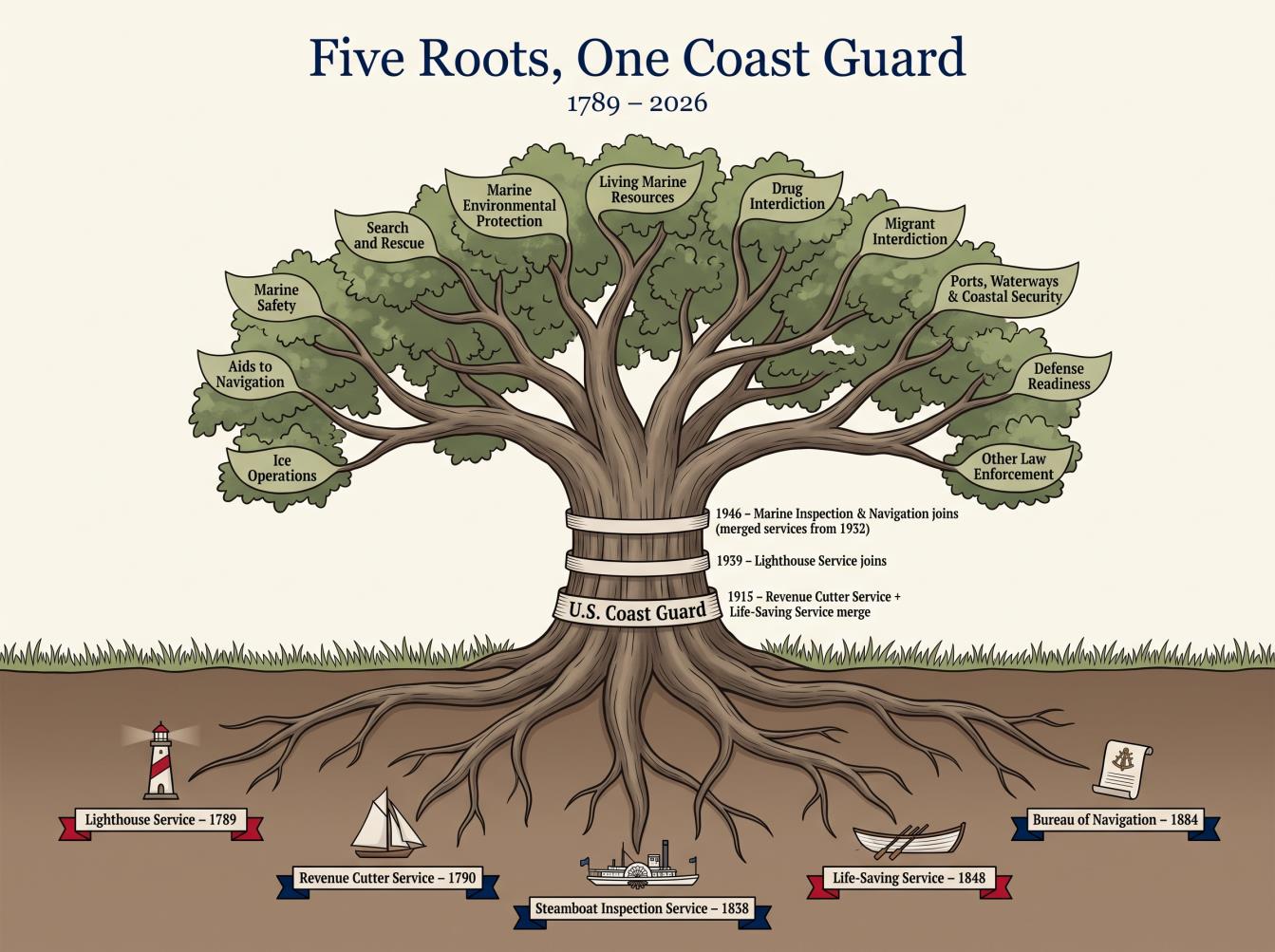
Still, the Coast Guard did not grow from one root. Today's service is the result of mergers among five older federal agencies, each with its own uniforms, traditions, heroes and missions:
- Lighthouse Service (1789)
- Revenue Cutter Service (1790)
- Steamboat Inspection Service (1838)
- Life-Saving Service (1848)
- Bureau of Navigation (1884)
The Revenue Cutter Service is the source of the Coast Guard's birthday, its military status and its cutters. The Lighthouse Service brought aids to navigation. The Life-Saving Service brought the surfboat and the motto that rescuers still live by. The Steamboat Inspection Service and the Bureau of Navigation brought the work of marine safety: licensing mariners, inspecting vessels and investigating casualties. Almost everything the Coast Guard does today, including much of what we do as Auxiliarists, can be traced to one of these five agencies.
Two Centuries of Mergers at a Glance
| Year | Event |
|---|---|
| 1789 | Ninth act of the First Congress places lighthouses, beacons and buoys under federal care (Aug. 7) |
| 1790 | Congress authorizes ten revenue cutters at Hamilton's request (Aug. 4), the Coast Guard's official birthday; the service is part of the Treasury Department |
| 1838 | First federal steamboat inspection law (July 7) |
| 1848 | Newell Act funds the first federal lifesaving stations on the New Jersey shore (Aug. 14) |
| 1852 | Lighthouse Board created; Steamboat Act creates a true federal inspection service |
| 1876 | Revenue Cutter School of Instruction founded (July 31), today's Coast Guard Academy |
| 1878 | Life-Saving Service becomes a separate agency under Sumner Kimball |
| 1884 | Bureau of Navigation created (July 5) |
| 1894 | Revenue Marine formally renamed Revenue Cutter Service |
| 1910 | Lighthouse Board replaced by the Bureau of Lighthouses |
| 1915 | Revenue Cutter Service + Life-Saving Service = U.S. Coast Guard (Jan. 28), still under the Treasury |
| 1917–1919 | Coast Guard operates as part of the Navy during World War I (Apr. 6, 1917 – Aug. 28, 1919) |
| 1932 | Steamboat Inspection and Navigation bureaus merge |
| 1936 | Renamed Bureau of Marine Inspection and Navigation |
| 1939 | Lighthouse Service joins the Coast Guard (July 1); Coast Guard Reserve, today's Auxiliary, created (June 23) |
| 1941–1946 | Coast Guard operates as part of the Navy during World War II (Nov. 1, 1941 – Jan. 1, 1946) |
| 1942–1946 | Marine inspection functions move to the Coast Guard, temporarily in 1942 and permanently in 1946 |
| 1967 | Coast Guard moves from the Treasury to the new Department of Transportation (Apr. 1) |
| 2003 | Coast Guard moves to the new Department of Homeland Security (Mar. 1) |
The Revenue Cutter Service (1790–1915): Hamilton's "System of Cutters"
The young republic was poor. Under the Articles of Confederation the government could not collect taxes, and once the Constitution was ratified it relied almost entirely on tariffs on imported goods. Smuggling was common and widely tolerated, as it had been under British rule. Hamilton saw that the Treasury needed enforcement at sea, and on August 4, 1790, Congress authorized the construction of ten cutters for that work.
These were small, fast sailing vessels, a mix of two-masted schooners and single-masted sloops of 38 to 70 tons, each assigned to a coastal district from New Hampshire to Georgia. On March 21, 1791, President Washington commissioned Hopley Yeaton of New Hampshire as master of the cutter Scammel. He was the first seagoing officer commissioned under the new Constitution. Many historians believe Capt. John Foster Williams's Massachusetts was the first of the ten cutters to put to sea.
The service went by several names in its early decades: the "system of cutters," the Revenue Service and, most often, the Revenue Marine. Congress made "Revenue Cutter Service" the official name in 1894. Under any name it was for several years the nation's only armed force afloat. The Continental Navy had been disbanded after the Revolution. Congress did not authorize a new navy until 1794, its first frigates were not at sea until 1797, and the Navy Department was not created until 1798. When the Quasi-War with France began that year, revenue cutters sailed alongside the new Navy and captured or helped capture French privateers. This began a tradition that holds today: in wartime, the Coast Guard serves with the Navy.
Over the next century the cutters acquired almost every maritime mission the government had to give. They enforced the 1808 ban on the importation of enslaved people, fought pirates in the Gulf of Mexico, enforced quarantine, protected timber reserves, patrolled the Bering Sea fur-seal grounds and helped mariners in distress. The cutter Harriet Lane is credited with firing the first shot from a vessel in the Civil War, across the bow of a merchant steamer off Fort Sumter in April 1861.
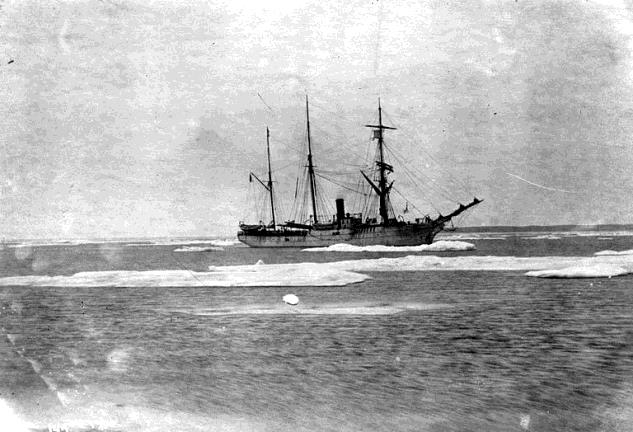
After the United States purchased Alaska in 1867, the Revenue Cutter Service became the federal government's presence in the territory. For decades the cutters carried judges, doctors, teachers and mail to its remote villages. In the winter of 1897–98, eight whaling ships were trapped in the ice near Point Barrow. 1st Lt. David Jarvis, 2nd Lt. Ellsworth Bertholf and Surgeon Samuel Call, all of the cutter Bear, traveled more than 1,500 miles overland, driving a herd of reindeer to feed the stranded crews. All three received Congressional Gold Medals. Bertholf later became the first Commandant of the U.S. Coast Guard.
The service also needed trained officers. On July 31, 1876, Congress established the Revenue Cutter School of Instruction, and in May 1877 its first class of nine cadets went to sea aboard the schooner James C. Dobbin. That school became the U.S. Coast Guard Academy in New London, which marked its 150th anniversary this summer.
The Lighthouse Service (1789–1939): Older Than the Cutters
The revenue cutters are the source of the Coast Guard's birthday, but the lighthouses came under federal care first. The Coast Guard nevertheless counts its age from 1790, because it descends directly from the Revenue Cutter Service; the Lighthouse Service was a separate civilian bureau that did not join until 1939. On August 7, 1789, a year before Hamilton's cutters, the First Congress passed its ninth law, "An Act for the establishment and support of Lighthouses, Beacons, Buoys, and Public Piers." The twelve colonial lighthouses, including Boston Light (first lit in 1716), became federal property under the Secretary of the Treasury. August 7 is still observed as National Lighthouse Day.
For several decades the system was run with an eye to economy, and the quality of the lights suffered. In 1852 Congress replaced that arrangement with a nine-member Lighthouse Board of naval officers, Army engineers and scientists. The Board adopted the French Fresnel lens and expanded the system rapidly. When it took over in 1852 there were 331 lighthouses and 42 lightships. By the end of the century the number of aids to navigation had grown to the thousands.
In 1910 Congress replaced the Board with the Bureau of Lighthouses in the Department of Commerce and Labor (the Department of Commerce after 1913), headed by Commissioner George R. Putnam. During his 25 years in charge, the service added radio beacons, electrified many lights and automated others.
The Lighthouse Service is also part of the history of women in federal service. Long before women could vote, many of them served as lighthouse keepers. Some succeeded husbands or fathers who had died, and others were appointed in their own right. Ida Lewis of Lime Rock, R.I., was credited with saving at least 18 lives and became one of the most famous women in America.
On July 1, 1939, under President Franklin Roosevelt's Reorganization Plan No. II, the Lighthouse Service was consolidated into the Coast Guard. Its keepers could join the Coast Guard or remain civilians, and many of them stayed at their lights for the rest of their careers. The Coast Guard has maintained the nation's aids to navigation ever since, and Auxiliarists help with that work today through the Aids to Navigation and Chart Updating programs.
The Life-Saving Service (1848–1915): The Surfmen
Before the Civil War, shipwreck rescue in America was mostly a matter of volunteers. The Massachusetts Humane Society had built huts of refuge on its coast since 1787 and its first lifeboat station in 1807. On August 14, 1848, the Newell Act, championed by New Jersey Rep. William A. Newell, appropriated $10,000 for lifesaving equipment and unmanned boathouses on the New Jersey shore between Sandy Hook and Little Egg Harbor. More stations followed, but they relied on volunteers and were poorly maintained.
The man who transformed the system was Sumner Increase Kimball. In 1871 he was appointed chief of the Treasury Department's Revenue Marine Division. He went on to hire paid, full-time crews, build new stations, set professional standards, require constant drill and remove political appointees. In 1878 Congress made the Life-Saving Service a separate agency within the Treasury, with Kimball as General Superintendent. He held that post for its entire 37-year existence.
Each station was manned by a keeper and a crew of surfmen. Their duties included beach patrols on foot through the night in every kind of weather, rowing self-bailing surfboats through breaking seas, and firing a Lyle gun to send a line out to a stranded ship so that its crew could be brought ashore one at a time in a breeches buoy. A saying from those years, "You have to go out, but you don't have to come back," is still repeated in today's Coast Guard. It is unofficial, but it captures the service's attitude well.
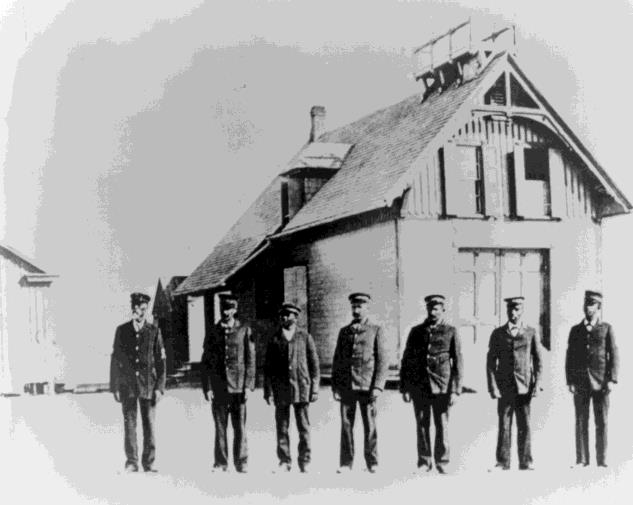
One of the best-known stories of the service comes from Pea Island on the Outer Banks of North Carolina. In 1880 Richard Etheridge, a formerly enslaved man and a Civil War veteran, became the first African American keeper of a lifesaving station. His all-Black crew became known as one of the best-drilled in the service. In October 1896, during a hurricane, they rescued all nine people aboard the schooner E.S. Newman. A century later, in 1996, the Coast Guard posthumously awarded Etheridge and his crew the Gold Lifesaving Medal.
By 1915 the Life-Saving Service operated more than 270 stations on the Atlantic, Gulf and Pacific coasts and the Great Lakes. On January 28 of that year, President Woodrow Wilson signed the Act to Create the Coast Guard, which combined the Life-Saving Service with the Revenue Cutter Service. Kimball retired and the stations became Coast Guard stations.
The Steamboat Inspection Service (1838–1932): Safety from Disaster
Steam power made river and coastal travel fast, but it also made it dangerous. Early boilers often exploded, and steamboat fires and explosions killed hundreds of passengers. On July 7, 1838, Congress passed its first law "to provide for the better security of the lives of passengers on board of vessels propelled in whole or in part by steam." The law required inspections of hulls and boilers, but the inspectors were local appointees paid by the boat owners, and the law had little effect.
After a further series of boiler explosions, Congress passed the Steamboat Act of August 30, 1852. It required hydrostatic testing of boilers and safety valves, required pilots and engineers to be licensed, and created a corps of supervising and local inspectors under the Treasury. This was the beginning of the Steamboat Inspection Service. It was one of the first federal regulatory agencies of its kind in the United States, and it was created in response to deaths that could have been prevented.
The disasters did not stop entirely. The burning of the excursion steamer General Slocum in New York's East River in 1904 killed more than 1,000 people and exposed rotted life preservers and untrained crews. It led to major reforms. The same pattern of disaster followed by investigation and reform still guides the Coast Guard's approach to marine safety.
The Bureau of Navigation (1884–1932): Documenting the Fleet
The Bureau of Navigation was created by the Act of July 5, 1884, to bring together various Treasury offices concerned with merchant ships. It was responsible for the documentation and admeasurement (official measurement of tonnage) of American merchant vessels, the collection of tonnage taxes, the work of shipping commissioners who oversaw the hiring of merchant seamen, and the enforcement of navigation laws generally.
The Bureau of Navigation is the least well-known of the five predecessors, but its work continues in the Coast Guard's National Vessel Documentation Center, which still issues certificates of documentation for American vessels.
The Long Road to Consolidation (1932–1946)
In 1932 the Steamboat Inspection Service and the Bureau of Navigation were merged into the Bureau of Navigation and Steamboat Inspection. After the 1934 fire aboard the liner Morro Castle off the New Jersey coast, which killed more than 130 people, Congress reorganized it again in 1936 as the Bureau of Marine Inspection and Navigation.
World War II brought the final consolidation. In 1942, with American merchant ships under attack from U-boats along the coast, President Roosevelt temporarily transferred marine inspection and merchant mariner licensing to the Coast Guard, while vessel documentation went temporarily to Customs. In 1946 the bureau was abolished and its marine safety functions were transferred permanently to the Coast Guard.
With that, all five roots of today's Coast Guard had come together.
Roots in Our Own Waters
Each of the five predecessor agencies left traces in the waters around Bellingham and the Salish Sea.
The first cutter north of San Francisco. In 1851 Congress created the Puget Sound customs district, and in 1854 the headquarters moved to Port Townsend. On September 28, 1854, the revenue cutter Jefferson Davis, a topsail schooner under Capt. William C. Pease, arrived at Port Townsend. It was the first revenue cutter stationed north of San Francisco. It patrolled against smuggling across the new and loosely enforced border with British territory, and it took part in the Puget Sound War of 1855–56.
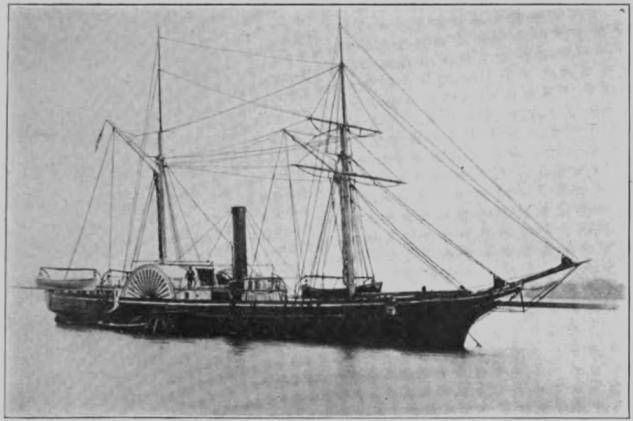
A tender that served two masters. The Shubrick was a sidewheel steamer built at the Philadelphia Navy Yard and sent to the Pacific through the Strait of Magellan, arriving at San Francisco in May 1858. It was the first lighthouse tender on the West Coast, and the first steam-powered lighthouse tender of any kind. During the Civil War it was transferred to the Revenue Cutter Service and was based at Port Townsend from mid-1862. It enforced customs laws in Puget Sound before returning to lighthouse duty.
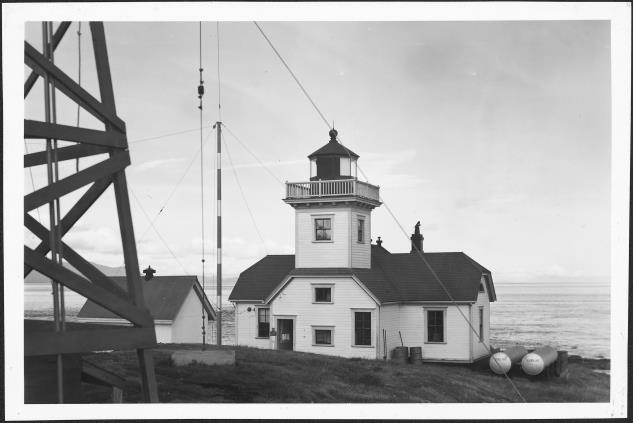
Lights in the San Juans. The light stations at Patos Island and Turn Point on Stuart Island were both established in 1893. Both still stand watch over Boundary Pass and Haro Strait, waters our flotilla's facilities know well. Patos Island was the setting for The Light on the Island, Helene Glidden's memoir of growing up as a keeper's daughter there in the early 1900s.
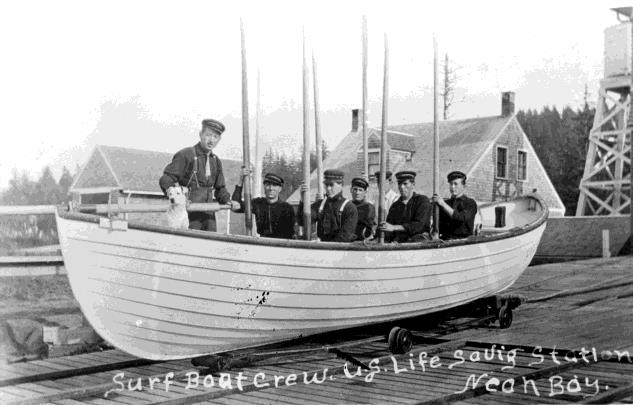
Makah and Quileute surfmen. A Life-Saving Service station was established at Neah Bay in 1877, on the Makah Reservation at the entrance to the Strait of Juan de Fuca. Under a non-Native keeper, nearly all of its surfmen were members of the Makah and Quileute tribes. This was one of the earliest federal units staffed mainly by Native Americans. The original station closed in 1890; a new station opened on Waaddah Island in 1908 and moved to Baadah Point on the mainland in 1910, where Coast Guard Station Neah Bay stands today.
The Sixth Root: Us
The Coast Guard has one more founding date that matters to our members. On June 23, 1939, a week before the Lighthouse Service merger, Congress passed the Coast Guard Reserve Act, which created a civilian, volunteer reserve of boat owners to promote boating safety and support the service. When Congress created a military Reserve in 1941, the civilian organization was renamed the U.S. Coast Guard Auxiliary.
Our predecessors are easy to recognize. Our vessel examiners do the same kind of work as the steamboat inspectors. Our aids-to-navigation and chart-updating volunteers are continuing the work of the Lighthouse Service. Our boat crews train for search and rescue, as the surfmen did on their beaches.
As the country marks its 250th year, the Coast Guard can look back on more than two centuries of service through five agencies. Their missions were brought together over a period of 31 years, from 1915 to 1946, into one service whose motto is Semper Paratus, Always Ready.
Sources
- U.S. Coast Guard Historian's Office. Coast Guard History: Chronology and Predecessor Agencies.
- U.S. Coast Guard Historian's Office. Steamboats & Bureau of Navigation bibliography.
- U.S. Coast Guard Historian's Office. Jefferson Davis, 1853.
- U.S. Coast Guard Historian's Office. Shubrick, 1857.
- U.S. Coast Guard Historian's Office. Station Neah Bay, Washington and Station Waaddah Island, Washington.
- U.S. Coast Guard Historian's Office. Native Americans in the U.S. Coast Guard.
- U.S. Coast Guard Historian's Office. The Long Blue Line: Training Ship Chase, the First Coast Guard Academy.
- National Archives. Records of the Bureau of Marine Inspection and Navigation (Record Group 41).
- National Park Service. History of Lighthouses.
- U.S. Life-Saving Service Heritage Association. History of the USLSS.
- HistoryLink.org. Patos Island Lighthouse (San Juan County).
- U.S. Coast Guard Auxiliary. History.