U.S. Coast Guard Auxiliary Flotilla 11 - Bellingham, WA

Mayday at Parker Reef
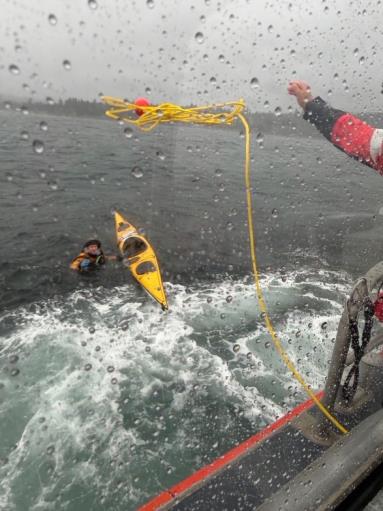
Parker Reef, Wash. — A Station Bellingham boat crew rescues a 45-year-old paddler after a wave capsized his kayak, Sept. 25, 2026. U.S. Coast Guard photo.

Dry suits, life jackets and a VHF radio save a capsized kayaker in the San Juans

On the morning of Friday, September 25, two kayakers were paddling near Parker Reef, between Orcas and Sucia islands, when a wave capsized one of them, a 45-year-old man, and put him in 54-degree water.
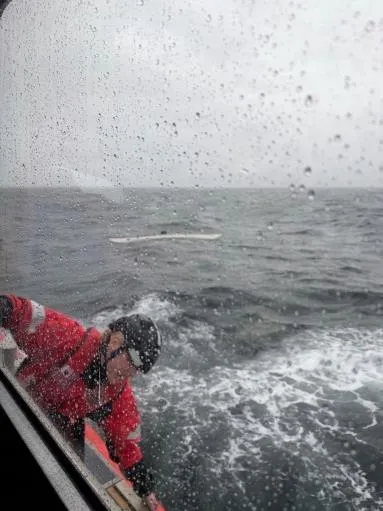
Parker Reef, Wash. — A Station Bellingham crew member works to reach the capsized paddler. U.S. Coast Guard photo.

At 8:09 a.m. he called a mayday on VHF channel 16 with his handheld radio. Watchstanders at the Coast Guard Northwest District command center launched a 45-foot Response Boat–Medium crew from Station Bellingham and an MH-65 Dolphin aircrew from Air Station Port Angeles.

The Station Bellingham boat crew arrived on scene at 9:12 a.m., pulled the man from the water and recovered his kayak. They brought him to Brandt's Landing Marina in Eastsound on Orcas Island, where emergency medical services were waiting. His paddling partner stayed upright and paddled safely to shore on his own.
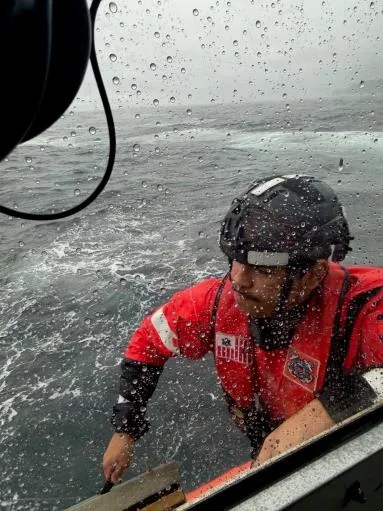
Parker Reef, Wash. — Petty Officer 3rd Class Mikko Smith, a crew member aboard Station Bellingham's 45-foot Response Boat–Medium, works to rescue the paddler. U.S. Coast Guard photo.

Conditions were not atypical for the Salish Sea: the Coast Guard reported 8 mph winds, 1-foot waves and 60-degree air. The danger was the water. At 54 degrees, cold water can quickly sap a swimmer's strength and ability to help himself.

Both men had done things right. They wore life jackets and dry suits, and they carried a VHF radio. "In cold water, every single second counts," said Lt. Allison Ruth, command duty officer for Coast Guard Sector Puget Sound. "This successful rescue was possible because the kayakers had dry suits, wore their life jackets and used a VHF radio to call for help."

It is the same message our public education classes and Vessel Safety Checks carry every season: dress for the water temperature, not the air; wear a life jacket; and carry a way to get help that works if you are in the water, such as a waterproof handheld VHF radio with digital selective calling (DSC) and built-in GPS, a personal locator beacon (PLB) or a satellite messenger.

Sources: U.S. Coast Guard news release, September 26, 2026; Cascadia Daily News; San Juan Islander.

Also in this issue

  • Northern Area Regional Training, November 6–7

    Two days at Coast Guard Base Seattle, November 6 and 7, on how the Auxiliary can serve the active-duty Coast Guard in Puget Sound.

  • New National Leadership Elected for 2026–2028

    The Auxiliary elected its national leadership for 2026–2028 in August. COMO Curtis Han will represent the Pacific Area, which includes our Northwest District.

  • New Ways to Serve: Paddles and Drones

    Two Auxiliary programs the Northwest District is developing: AuxPad puts members in kayaks alongside paddlers, and drone pilots support Coast Guard units.

  • Geospatial Damage Assessments
    By Kat Scanlon

    Auxiliarists help FEMA map disaster damage from satellite, aerial and open-source imagery, working from home. Here is the work and how to join the team.

  • Service Records: Steve Bell and Hoyt Hatfield

    A closer look at the Auxiliary careers of Steve Bell (24 years) and Hoyt Hatfield (25 years), who retired this summer: their qualifications, offices and awards.

  • Five Roots, One Coast Guard

    The Coast Guard grew from five older agencies, merged between 1915 and 1946. Their stories, their traces in the Salish Sea, and the Auxiliary's own root.

  • The Coast Guard in the News

    New Arctic piers and icebreakers, Operation Pacific Viper, a change of command at Air Station Port Angeles, and the Coast Guard at Bellingham SeaFeast.

  • Member Training

    New boat crew qualifications and recertifications, Coast Guard courses completed, and all of the flotilla’s scheduled training finished for 2026.

  • Navigation Systems

    Flotilla 11 has verified all five bridges in its area and 26 of its 44 private aids to navigation this year, with 18 private aids still to go.

  • Communication Services

    The flotilla website has been rebuilt: Alert 11 articles to read online, browsing by issue and topic, a Members Only area, and editing from the browser.

  • Parting Shot

    The sun sets over the Pacific as the Cape Disappointment Lighthouse stands vigil above the Columbia River Bar: the closing photo of Alert 11, Fall 2026.

NOTICE/DISCLAIMER

The information contained on this site is for general informational purposes only. It is not guaranteed to be free of errors. Links to non-Coast Guard entities are not under the control of the United States Coast Guard or the United States Coast Guard Auxiliary, and are provided for the convenience of our customers. They do not, in any way, constitute an endorsement of the linked pages or any commercial or private issues or products presented there. We cannot make any warranty or representation concerning the content of these sites, or secondary sites from the pages to which they link.

PRIVACY STATEMENT

This website is for the use of US Coast Guard Auxiliary members and the public who are interested in the activities and education programs of Flotilla 11. No personally identifiable information is captured from viewers of this site, except those who edit or create content. If you do not agree to these terms, please leave the site.
An unhandled error has occurred. Reload 🗙